Secure Multitenant Reporting with Row-Level Security (RLS)

Introduction
In multitenant SaaS platforms, securely isolating data between tenants while maintaining scalability and compliance is a persistent challenge. Bold Reports® addresses this with row-level security (RLS), a method that filters report data based on user roles, attributes, or tenant IDs to ensure each user sees only the data they’re authorized to view. This blog explores the benefits of RLS and highlights four real-world use cases where Bold Reports enables secure, scalable reporting for SaaS platforms.
Challenges in multitenant reporting without row-level security
Without row-level security, multitenant reporting in SaaS platforms presents several key challenges:
Data leakage risks: Reports may unintentionally expose one tenant’s data to users from another, leading to privacy violations and potential legal consequences.
Complex customization: Developers often need to create separate reports for each tenant to avoid data exposure, which increases development time and maintenance effort.
Scalability issues: As the number of tenants grow, managing individual reports or applying manual filters becomes inefficient and error-prone.
Compliance challenges: Regulations like GDPR and HIPAA require strict data access controls. Without RLS, ensuring and demonstrating compliance becomes difficult.
Poor user experience: Users may see irrelevant or excessive data, making reports confusing and reducing trust in the system.
7 benefits of implementing row-level security
Row-level security is a powerful feature that helps organizations enforce access control policies at the database level, ensuring that users only see the data they’re authorized to access. Here are seven key benefits of implementing it:
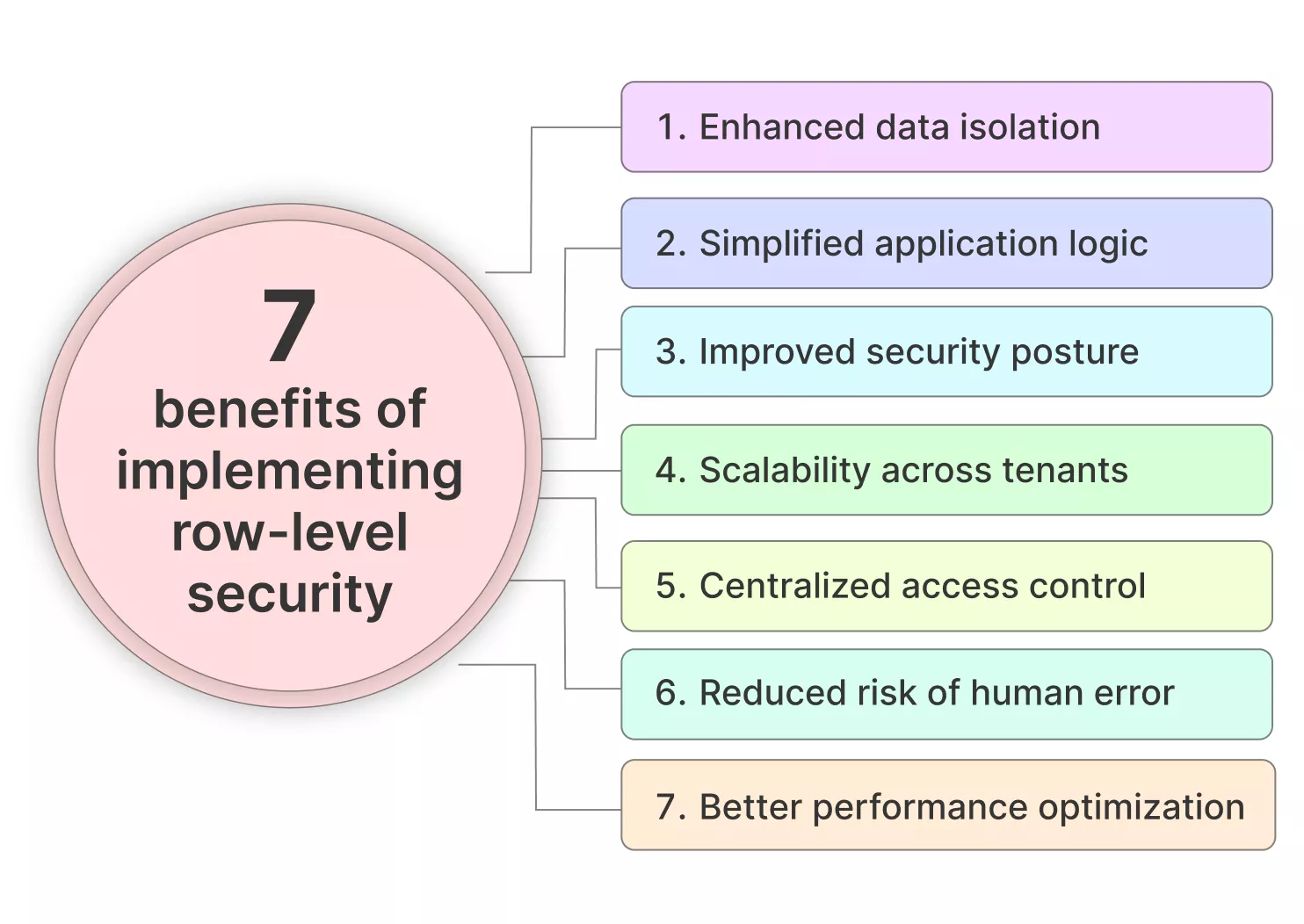
1. Enhanced data isolation: RLS ensures that each tenant can only access their own data. This isolation is enforced at the database level, reducing the risk of accidental data leaks or unauthorized access across tenants.
2. Simplified application logic: Instead of writing complex filtering logic in your application code, RLS allows you to define access rules directly in the database. This simplifies development and reduces the chance of errors in access control implementation.
3. Improved security posture: By enforcing access policies at the database level, RLS adds an extra layer of security. Even if application-level controls fail, RLS ensures that unauthorized access to data is blocked.
4. Scalability across tenants: As your platform grows, managing access for hundreds or thousands of tenants becomes easier with RLS. You can define scalable policies that automatically apply to new tenants without modifying application code.
5. Centralized access control: RLS enables centralized management of access rules, making it easier to audit, update, and maintain security policies. This is useful for compliance with data protection regulations like GDPR or HIPAA.
6. Reduced risk of human error: Manual filtering in application logic can lead to mistakes. RLS minimizes this risk by automating access control at the database level, ensuring consistent enforcement across all queries.
7. Better performance optimization: With RLS, queries are automatically filtered at the database level, which can lead to performance improvements by reducing the amount of data processed and transferred to the application layer.
Now that we know the benefits of row-level security, let’s explore the use cases of row-level security.
Use cases of row-level security in multitenant SaaS
In multitenant SaaS platforms, securely managing data access across different clients is essential. Row-level security ensures each tenant or user sees only data relevant to themselves without duplicating reports. The following are two use cases that show how RLS improves data isolation and personalization.
Sales
Event organizers, promoters, and venues often face challenges in securing ticket sales data across multiple clients in a shared SaaS setup. Without proper access control, sensitive sales information can be exposed between tenants, putting different parties at risk of compliance issues. The Ticket Sales Analysis sample report in Bold Reports uses row-level security to solve this. From the admin view, users can access ticket data across all clients to track ticket sales and report on them. From the event organizer’s view, each user sees only their own event data filtered by tenant ID and role, ensuring secure, personalized access and complete data isolation.

Energy
In the Bold Reports Power Plant Monitoring sample report, row-level security ensures users only see data relevant to their role or location. Admins can view all plant metrics across sites, while managers or technicians see only data for their assigned unit, like local equipment performance and alerts. Most multitenant environments face the challenge of securely delivering personalized data views to different users. RLS addresses this by dynamically filtering data based on user roles, eliminating the need for duplicate reports and enabling scalable, efficient reporting.

With a clear understanding of the use cases of row-level security, let us now explore the before and after states of its implementation in a Bold Reports sample report. To learn how to configure row-level security in Bold Reports, explore our documentation.
How row-level security works in Bold Reports
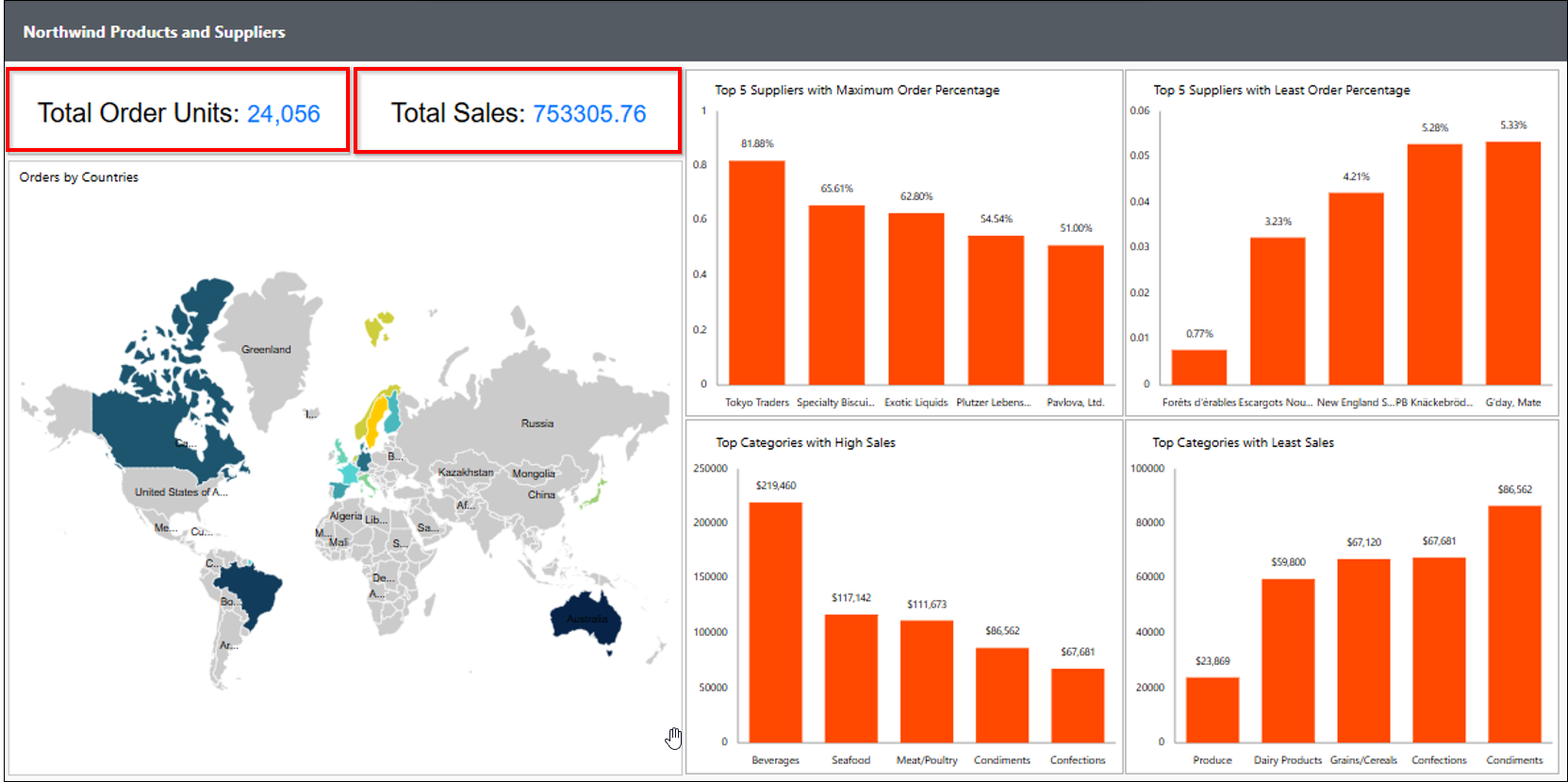
Row-level security in Bold Reports is implemented by using parameters to display data according to user roles. The sample dashboard shown in the following image displays comprehensive data across all departments, suppliers, and categories, with 24,056 total order units and $753,305.76 in total sales. Row-level security has not been applied in this dashboard yet. This unrestricted view, intended for administrators, includes global order distribution and full supplier performance metrics.
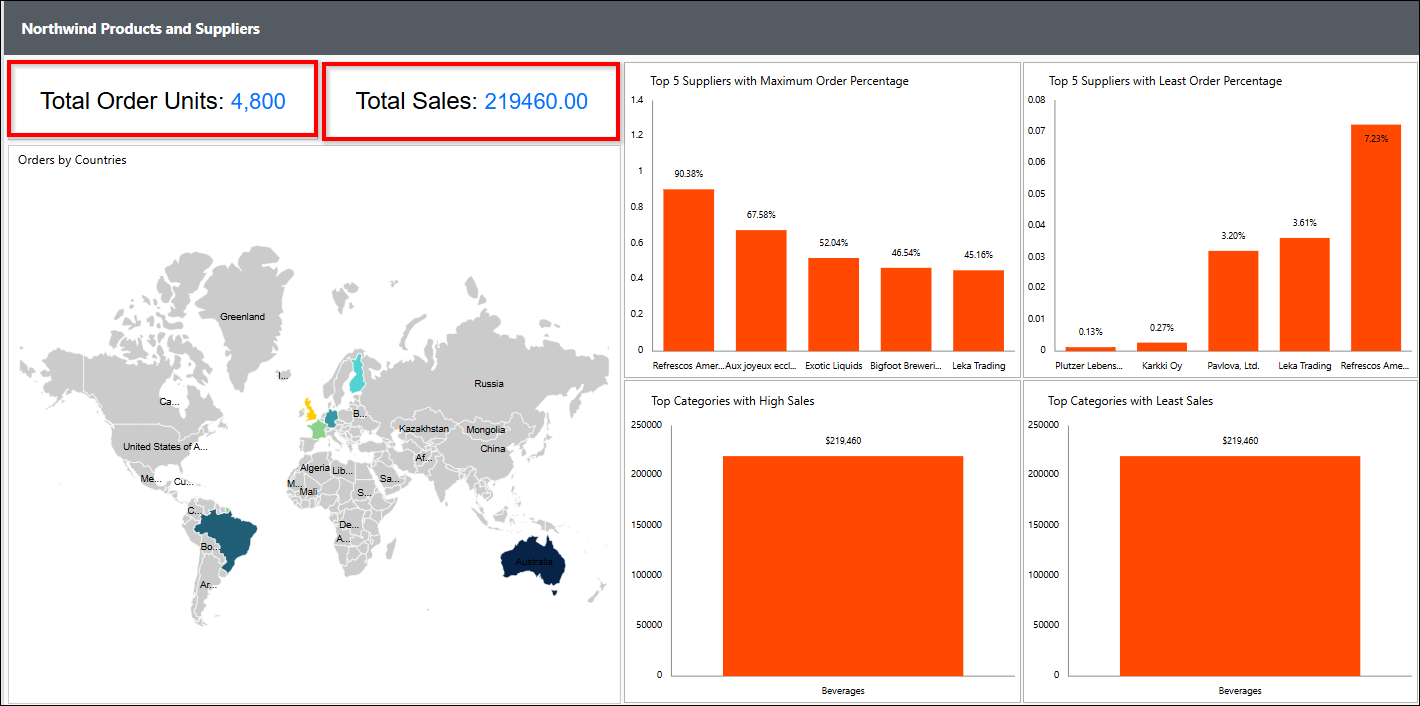
After RLS is applied, the report is filtered to show only the data relevant to a specific user or department, reducing total order units to 4,800 and total sales to $219,460.00. This view is designed specifically for departmental managers, ensuring that each one accesses only the data relevant to their department. This approach enhances both data relevance and privacy.
To learn how to filter data in Bold Reports, check out our documentation. Report parameters allow you to customize data views based on user input, making your reports more dynamic and interactive. This feature is especially useful when working with large datasets or implementing user-based filtering, as it enables targeted data access and enhances report usability.
Keep sensitive data safe with row-level security!
Row-level security empowers organizations to protect sensitive data with precision and flexibility. By standardizing roles, using hierarchical structures, and auditing regularly, you can maintain control without sacrificing efficiency. Adding dynamic access controls and monitoring usage further strengthens your security posture.
Ready to take your data protection strategy to the next level? Start implementing these RLS best practices with Bold Reports® today! Sign up for a 30-day free trial or request a personal demo with our product experts to experience Bold Reports firsthand. If you’re new to the platform, schedule an onboarding call and let us take you through your first steps with ease.


